
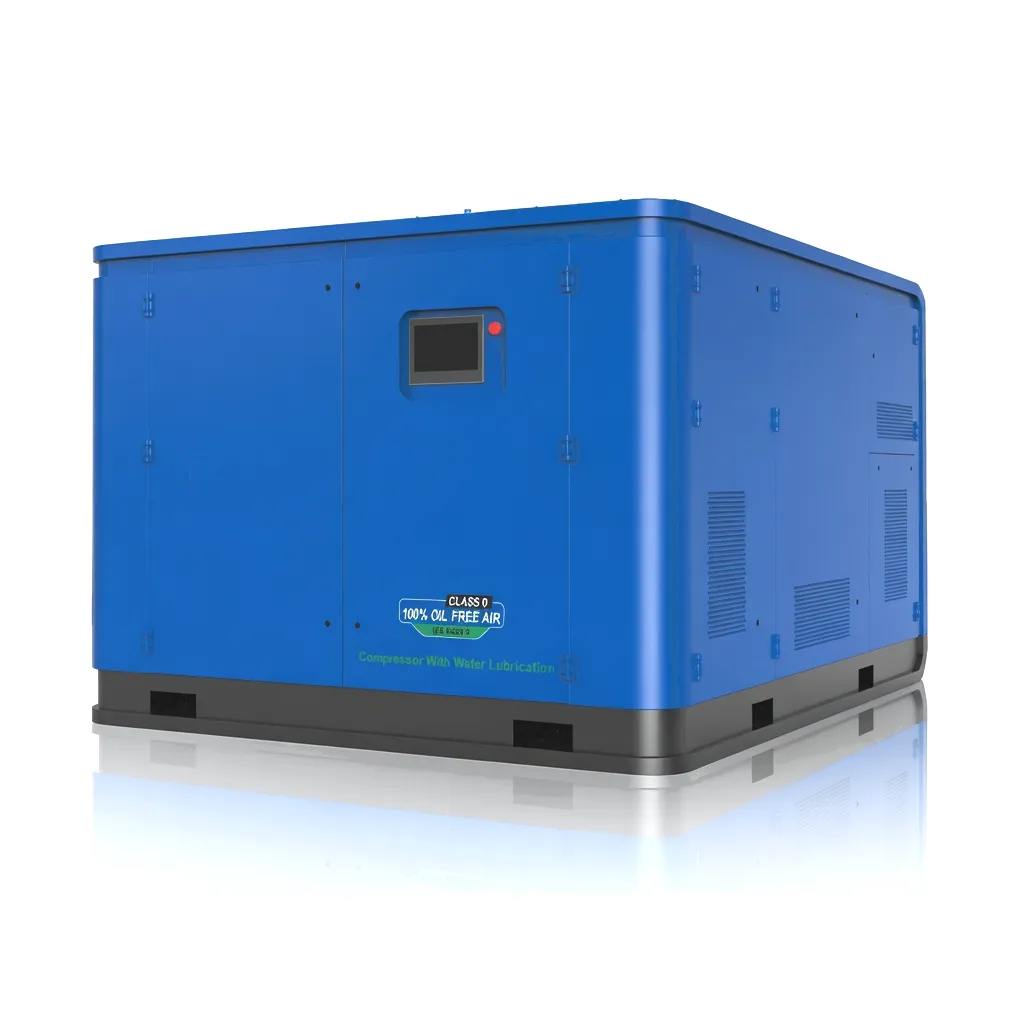
 Within the UK’s advanced manufacturing landscape, compressed air ranks as the fourth utility — sitting alongside electricity, gas, and water as an indispensable energy vector. Across Birmingham’s precision machining shops, Sheffield’s specialty steel plants, and the aerospace supply chains of the East Midlands, the demand for reliable, energy-efficient compressed air systems has never been more acute. The variable frequency screw air compressor has emerged as the definitive solution for facilities that need to balance throughput demands against escalating energy costs and increasingly stringent environmental compliance requirements.
How a Variable Frequency Screw Air Compressor Actually Works
Rotary Screw Compression
Two helical rotors — one male (four lobes) and one female (six grooves) — mesh together inside a precision-machined casing. As they rotate, air is drawn into the inlet, trapped between the rotor profiles, and progressively compressed as the screw geometry reduces the trapped volume. There are no reciprocating parts, no valves to wear, and no surge capacity limitations as found in centrifugal machines.
Variable Frequency Drive Integration
A VFD (also called an inverter) sits between the mains supply and the drive motor. It converts AC power to DC, then synthesises a new AC waveform at precisely the frequency needed to spin the motor at the required speed. The control system continuously measures outlet pressure and compares it with the setpoint; when demand falls, the inverter reduces frequency — and therefore motor speed — within milliseconds, avoiding the energy-wasting unload cycle entirely.
Oil-Injection Cooling Circuit
Compression generates significant heat; unchecked, this would damage rotor surfaces and lubricant. A continuous oil-injection system floods the compression chamber, simultaneously lubricating the rotors, sealing the clearance gap between male and female profiles, and absorbing heat. The hot oil-air mixture passes through a precision separator, then an oil cooler, before returning to the injection point. A thermostat valve bypasses the cooler during cold starts to prevent moisture condensation.
Understanding the pressure ratio across the screw element is critical for UK plant engineers specifying equipment. Most industrial applications in Britain require working pressures in the 7–13 bar range, which corresponds to typical pressure ratios of 7:1 to 13:1 across the element. The rotor profile — specifically the wrap angle and the asymmetric 4+6 lobe configuration — is engineered to minimise internal leakage (slip) at these ratios without over-compressing the air, which would waste energy through unnecessary heating. Leading manufacturers employ computational fluid dynamics modelling to optimise the rotor profile for specific duty cycles, a discipline that separates premium screw air compressors from lower-tier alternatives that copy external geometries without the underlying thermodynamic engineering.
The pressure control band — the difference between load and unload setpoints on a fixed-speed machine, or the control deadband on a VFD machine — directly impacts energy efficiency. A screw air compressor operating with a tight 0.2 bar band around its setpoint will consume measurably less energy than one with a 1 bar band, because the average system pressure (and therefore the specific power) is lower. Modern PLC-based controllers on premium variable frequency screw compressors maintain this band automatically, adjusting for altitude, ambient temperature, and filter pressure drop in real time.
Core Materials: What Sets a Premium Screw Compressor Apart
Bearings
Angular contact ball bearings in the ABEC-7 tolerance class locate the rotor axially; cylindrical roller bearings handle radial loads. Top-tier compressors use SKF or FAG bearings with L10 lives exceeding 100,000 hours at rated load.
Shaft Seals
PTFE-lip seals or labyrinth seals prevent oil migration to the drive-end bearing cavity. High-pressure models (above 13 bar) commonly use mechanical face seals, with carbon-graphite rotating faces running against silicon carbide seats.
Oil Separator Element
Borosilicate glass-fibre coalescing media, graded from 5 micron to submicron, captures oil aerosols. Residual oil carry-over on quality machines is below 3 mg/m³ — essential for laser cutting, food processing, and pharmaceutical applications.
Cooler Cores
Aluminium-brazed bar-and-plate aftercoolers are standard; stainless steel shell-and-tube configurations are specified for offshore, food-grade, and corrosive-gas environments. Effective aftercooling reduces discharge air to within 5°C of ambient temperature.
Product Technical Performance Parameters
The table below covers representative specifications from the variable frequency screw air compressor range offered by Ever Power. All flow rates are given as Free Air Delivery (FAD) measured to ISO 1217:2009 Annex C conditions (inlet 1 bar abs, 20°C, 0% relative humidity). Specific power (kW per m³/min FAD) is the key efficiency metric — lower is better. Values shown are at the nominal setpoint pressure; actual consumption varies with VFD speed.
| Model | Motor Power (kW) | FAD @ 8 bar (m³/min) | FAD @ 10 bar (m³/min) | Pressure Range (bar) | Specific Power (kW/m³/min) | Noise Level dB(A) | VFD Speed Range (Hz) | Discharge Temp (°C above ambient) | Oil Carry-over (mg/m³) |
|---|---|---|---|---|---|---|---|---|---|
| EP-VF22 | 22 | 3.6 | 3.0 | 5 – 13 | 6.11 | 65 ±2 | 25 – 60 | ≤8 | ≤3 |
| EP-VF37 | 37 | 6.3 | 5.2 | 5 – 13 | 5.87 | 66 ±2 | 25 – 60 | ≤8 | ≤3 |
| EP-VF55 | 55 | 9.8 | 8.1 | 5 – 13 | 5.61 | 68 ±2 | 25 – 60 | ≤8 | ≤3 |
| EP-VF75 | 75 | 13.5 | 11.2 | 5 – 13 | 5.56 | 69 ±2 | 25 – 60 | ≤8 | ≤3 |
| EP-VF110 | 110 | 20.2 | 16.8 | 5 – 13 | 5.45 | 70 ±2 | 25 – 60 | ≤8 | ≤3 |
| CM160PVF | 160 | 28.0 | 23.5 | 5 – 13 | 5.71 | 72 ±2 | 25 – 60 | ≤8 | ≤3 |
All specifications measured per ISO 1217:2009 Annex C. Data subject to engineering revision. Contact Ever Power for certified test reports.
Six Technical Advantages That Justify the Investment
30–50% Energy Reduction Over Fixed-Speed Units
The VFD eliminates the unloaded running period that wastes 15–25% of rated power on fixed-speed machines. At partial load — typically 60–80% of peak capacity in manufacturing environments — the inverter-driven screw air compressor operates at proportionally lower speed and power draw. For a UK plant running a 75 kW compressor at an average electricity cost of £0.28/kWh for 6,000 hours per year, the annual saving against a fixed-speed equivalent can exceed £18,000 — a payback period well under three years in most cases.
Precise Pressure Stability (±0.1 bar)
Because the VFD modulates continuously rather than switching between on and off states, the outlet pressure remains within an extraordinarily tight band — typically ±0.1 bar of setpoint. This matters enormously for end-uses such as laser cutting, where pressure fluctuations above ±0.3 bar produce visible quality variation in cut edges, and pharmaceutical tablet compression, where air pressure consistency directly affects tablet hardness uniformity and regulatory compliance.
Extended Mechanical Service Life
Fixed-speed compressors accumulate motor starts — each start event subjects the windings to 6–8x rated current for several seconds, degrading insulation incrementally. A variable frequency screw air compressor starts under VFD control at near-zero speed, limiting inrush current to rated value and eliminating mechanical shock entirely. The result is dramatically extended motor winding life, reduced coupling fatigue, and lower bearing wear rates — which translates directly into longer intervals between planned maintenance visits.
Soft-Start Eliminates Grid Demand Charges
In the UK, Maximum Demand (MD) charges on commercial electricity tariffs are calculated from the peak 30-minute interval consumption. A Direct-on-Line (DOL) started fixed-speed compressor can spike demand by 6–8x rated current for several seconds during start, pushing the MD reading higher and increasing the MD charge for the entire billing period. VFD soft-start completely eliminates this spike, often reducing the MD reading by 15–25% at facilities running multiple compressors — a significant secondary saving rarely factored into initial procurement decisions.
Integrated IoT Monitoring and Remote Diagnostics
Modern variable frequency screw air compressors ship with embedded PLC controllers that log over 30 operating parameters at one-minute intervals — outlet temperature, oil pressure, filter differential, bearing vibration, and motor current among them. Ethernet-connected units push this data to cloud-based dashboards accessible from desktop or mobile, enabling UK maintenance teams to monitor compressor health without physical site visits. Predictive maintenance algorithms flag anomalies weeks before they develop into failures, a capability increasingly demanded by ISO 55001 asset management frameworks.
Low Acoustic Profile for Workspace Integration
The absence of intake valve clatter and the smooth torque characteristic of VFD-controlled motors reduce acoustic emission by 4–8 dB(A) compared with fixed-speed equivalents of the same capacity. At 65–72 dB(A) at 1 metre (per ISO 2151), these screw air compressors can be installed in workspaces adjacent to occupied offices without violating UK Control of Noise at Work Regulations 2005 upper exposure limits, removing the requirement for dedicated compressor rooms in many smaller facilities.
Industrial Application Scenarios Across UK Manufacturing Sectors
Application Scenario 2: Pharmaceutical Manufacturing in Cambridge and the Oxford–Cambridge Arc
The pharmaceutical corridor stretching between Cambridge and Oxford hosts some of the UK’s most demanding compressed air consumers. Tablet press machines, blister packaging lines, and lyophiliser loading systems all require instrument-quality air classified to ISO 8573-1 Class 1 or Class 2 standards — meaning particulate content below 0.1 micron, pressure dew point at or below -40°C, and total oil content below 0.01 mg/m³. These requirements make the choice of oil-free or oil-flooded-with-filtration screw air compressors a critical compliance decision rather than merely a commercial one. The variable frequency screw air compressor integrates naturally into SCADA-controlled cleanroom environments; its PLC output connects directly to Building Management Systems for centralised monitoring, and the smooth pressure delivery eliminates the minor pulsations that can affect sensitive filling and dosing equipment calibration.
Application Scenario 3: Automotive Assembly Plants in Sunderland and Derby
Large automotive assembly plants — including the Nissan facility in Sunderland and Rolls-Royce’s operations in Derby — require compressed air systems capable of sustaining high, variable flows across dozens of simultaneous end-uses: pneumatic tooling on assembly lines, robotic spray painting booths, tyre inflation stations, and air-powered conveyance systems. A centralised ring-main fed by multiple variable frequency screw air compressors operating in cascade provides the redundancy and capacity modulation that such facilities demand. The cascade control algorithm continuously sequences the compressors, bringing units online or offline as total demand changes, with each machine operating at its most efficient partial-load point rather than cycling through wasteful unloaded periods.
 The food and drink manufacturing belt across Yorkshire and Lancashire — encompassing everything from dairy processing in the Yorkshire Dales to major biscuit and confectionery operations near Manchester — represents one of the largest compressed air consumer segments in UK industry. Food-grade compressed air must comply with British Compressed Gases Association (BCGA) guidance CP4 and ISO 8573-1 purity classes relevant to the contact and non-contact distinction. Variable frequency screw air compressors in this sector typically feed pneumatic conveying lines for granular ingredients, packaging machinery, blow moulding systems for PET containers, and high-speed filling nozzles. The VFD’s ability to maintain steady pressure during demand surges — such as when multiple filling lines start simultaneously after a production break — prevents the pressure dips that cause packaging seal failures and product waste events.
Application Scenario 5: Specialty Steel and Metals Processing in Sheffield
Sheffield’s identity as the global centre of specialty steel and advanced alloys manufacturing means that the compressed air systems serving this sector face uniquely challenging environments — elevated ambient temperatures near furnaces, airborne metallic particulates, and widely swinging demand profiles as furnace charging, rolling, and heat treatment operations cycle. High-capacity variable frequency screw air compressors in the 110–160 kW range serve multiple simultaneous roles: supplying instrument air for actuators controlling process gas flow, providing clean air to positive-pressure control rooms protecting personnel from metallic dust, and feeding pneumatic quench water spray systems. The VFD’s load-following capability means these systems respond within milliseconds to the sudden demand spikes that occur when large pneumatic actuators operate simultaneously during batch changeovers.
Customer Success Story: Sheffield Precision Components Ltd
“The pressure stability we’re seeing from the Ever Power units is genuinely exceptional. We run a 10-head laser cutting line and previously had to pad our cut time by 8% to account for pressure variation causing quality issues at the end of a long run. Since the VFD compressors went in, we’ve eliminated that buffer entirely. The machine pays for itself just in throughput gain.”
— David Hartley, Operations Director
Hartley Sheet Metal Ltd, Coventry
“We specified the custom ATEX Zone 2 configuration for our solvent-based coating area. Ever Power’s team provided full certification documentation, including the ATEX Declaration of Conformity, within three weeks of our order confirmation — faster than any European supplier we’d trialled previously. The unit has been running 24/7 for eight months without a single alarm event.”
— Sarah Nkosi, Engineering Manager
NorthCoat Industrial Finishers, Leeds
“The energy audit data that Ever Power’s team provided upfront — mapping our existing demand profile against their compressor performance curves — gave us the commercial justification we needed to pass the capital approval. The actual measured saving in year one came within 4% of their projection. That level of accuracy in a pre-sales technical analysis is rare, and it’s built significant trust with our finance team for future projects.”
— James Whitfield, Maintenance & Reliability Manager
Sheffield Precision Components Ltd, Sheffield
Featured Variable Frequency Screw Air Compressor Models
CM160PVF Variable Frequency Screw Air Compressor
The CM160PVF is a 160 kW heavy-duty variable frequency screw air compressor engineered for continuous high-demand industrial environments. With a FAD of 28.0 m³/min at 8 bar, integrated IE4-efficiency motor, and a VFD speed range of 25–60 Hz, this unit delivers exceptional specific power of 5.71 kW/m³/min. Ideal for automotive assembly plants, large fabrication shops, and multi-shift production facilities across the UK.
Variable Speed Drive Screw Air Compressor
This mid-range variable speed drive screw air compressor covers the 22–75 kW power bracket with full VFD integration from the factory. Designed for SME manufacturers, laser cutting workshops, and pharmaceutical processing facilities where energy efficiency and pressure consistency are paramount, it features an intelligent PLC controller with Ethernet connectivity for remote monitoring and demand-side energy management integration.
Frequently Asked Questions
edit by gzl