18+ Years in Compressed Air Engineering · Updated June 2025
10 min read
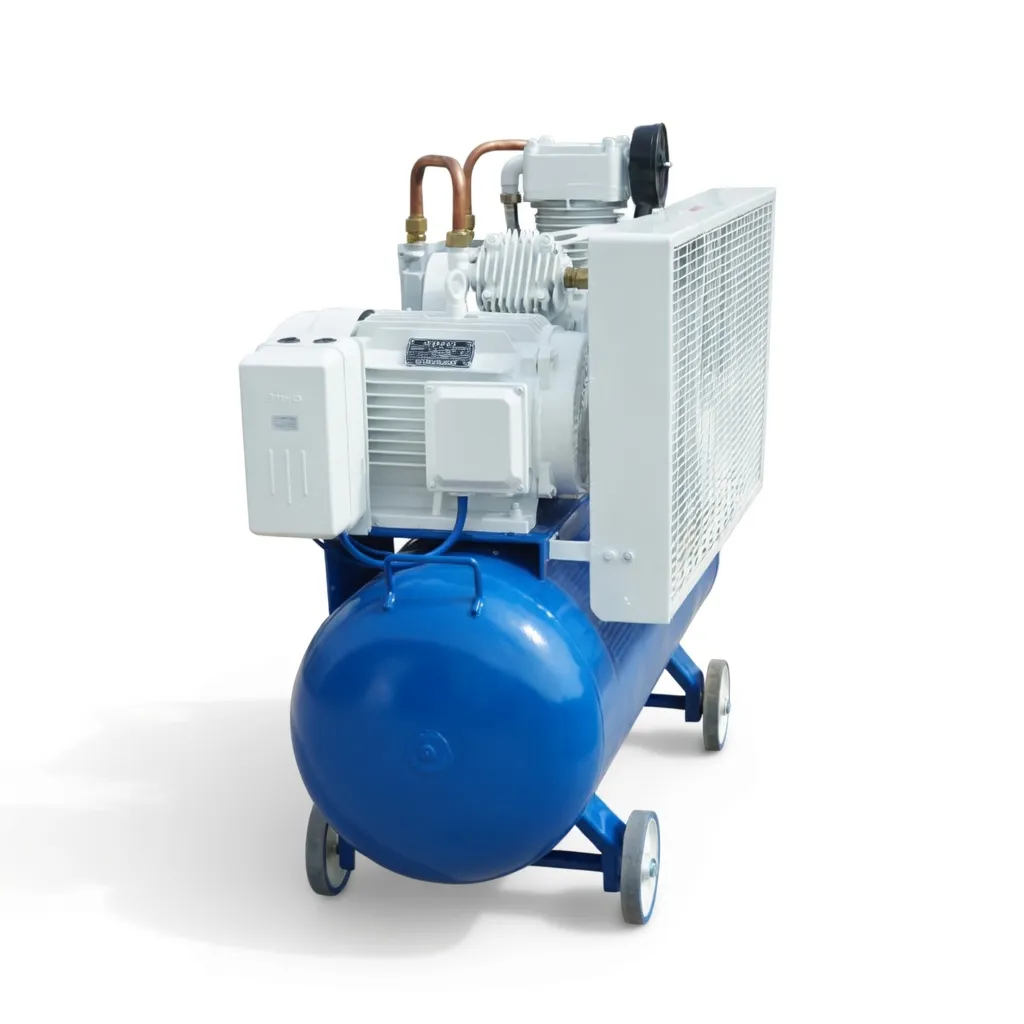 Walk through any modern crisp factory, coffee roasting plant, or biscuit production line in the UK, and one piece of infrastructure quietly underpins everything: the compressed air system. It seals packs, moves product through pipes, actuates valves, and — critically in modified atmosphere packaging — displaces oxygen with food-safe gas mixtures. What many procurement teams still underestimate is that the quality of that compressed air directly determines whether the food reaching shelves is safe, shelf-stable, and legally compliant.
A single oil-lubricated compressor, even with downstream filtration, introduces a residual contamination risk that ISO 8573-1 Class 1 barely tolerates and Class 0 refuses entirely. For snack foods, nuts, and coffee — products with high fat content that oxidise rapidly and absorb taints aggressively — the argument for an oil-free air compressor is not theoretical. It is a hard commercial and food safety necessity. This guide walks through the engineering, the compliance framework, the real-world performance data, and the practical decisions UK food manufacturers need to make in 2025.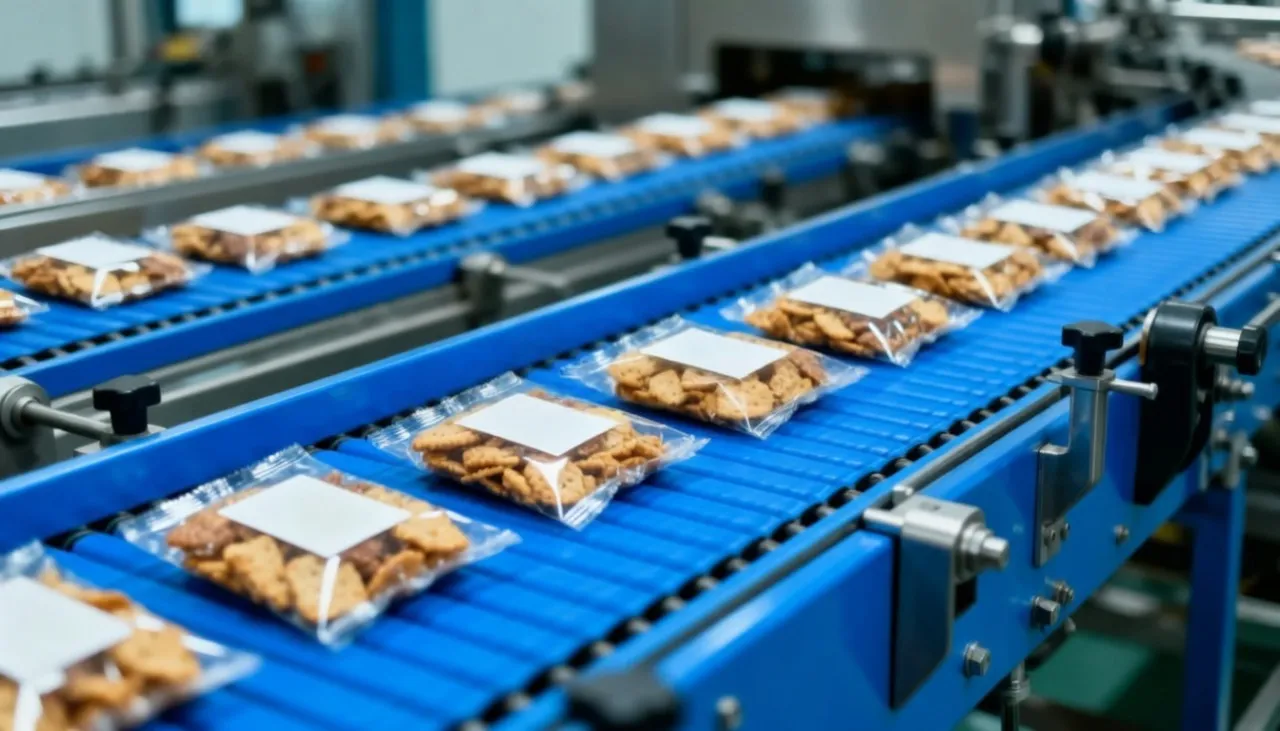
Why Oil in Compressed Air Is a Critical Food Safety Hazard
 Compressed air in food manufacturing is classified as a food contact material under UK and EU regulations, even after Brexit retained the essential food safety framework under UK HACCP guidance. This means the same standard of care applied to packaging film, process water, or food-grade lubricants must be applied to every cubic metre of air that touches, moves, or seals a product.
Oil aerosols from a lubricated compressor, even in concentrations measured in parts per million, cause four distinct categories of problem. The most immediate is sensory: fatty snack foods like crisps and nuts absorb hydrocarbon odours from mineral oil within days, producing rancid off-flavours that consumers detect before any analytical instrument flags a breach. The second concern is microbiological — oil films on interior pipe surfaces trap moisture and provide nutrients for biofilm formation, meaning a contaminated compressed air system is also a vector for Listeria and Pseudomonas in a chilled production environment.
Third, and increasingly the concern of procurement managers after high-profile recalls, is regulatory exposure. UK Food Standards Agency (FSA) enforcement, BRCGS audits, and retailer codes of practice (Tesco, Sainsbury’s, M&S all maintain their own supplier quality standards) explicitly reference compressed air quality. A single failed compressed air audit can result in supply suspension worth hundreds of thousands of pounds. Finally, there is the operational reality: oil carry-over accelerates wear on pneumatic valves and flow meters, increases maintenance frequency, and reduces the service life of MAP gas analysers — all costs that do not appear on the compressor’s purchase invoice but accumulate invisibly across production shifts.
Sensory Taint
Hydrocarbon odours absorbed by high-fat products within days
Biofilm Risk
Oil films fuel Listeria & Pseudomonas growth in pipework
Audit Failure
BRCGS & retailer codes flag non-compliant compressed air
Equipment Wear
Accelerated valve & flow meter degradation on the line
ISO 8573-1: The Standard Every UK Food Producer Must Know
ISO 8573-1 is the international standard specifying purity classes for compressed air across three contaminant categories: particulate matter, humidity (water), and oil. For food contact applications, the oil classification is the decisive parameter. The standard runs from Class 0 (the most stringent — no detectable oil whatsoever) through Class 4 (up to 5 mg per cubic metre). UK food manufacturers supplying major grocery retailers are increasingly required to demonstrate Class 0 or Class 1 compliance, with Class 0 becoming the default expectation for direct-contact packaging gases and MAP nitrogen flushing.
| ISO Class | Total Oil Content (mg/m³) | Food Application Suitability | Compressor Type Required |
|---|---|---|---|
| Kelas 0 | As specified (typically < 0.001) | ✓ Direct contact — MAP gas, aseptic | Oil-free only |
| Class 1 | ≤ 0.01 | ✓ Near-contact packaging & conveying | Oil-free (recommended) |
| Class 2 | ≤ 0.1 | ⚠ Non-contact utility (actuators, tools) | Lubricated + high-efficiency filtration |
| Class 3–4 | ≤ 1.0 – 5.0 | ✗ Not suitable for food manufacturing | Standard lubricated |
Source: ISO 8573-1:2010. Class 0 is defined by agreement between user and supplier and must be specified in the purchase contract.
How an Oil-Free Air Compressor Actually Works
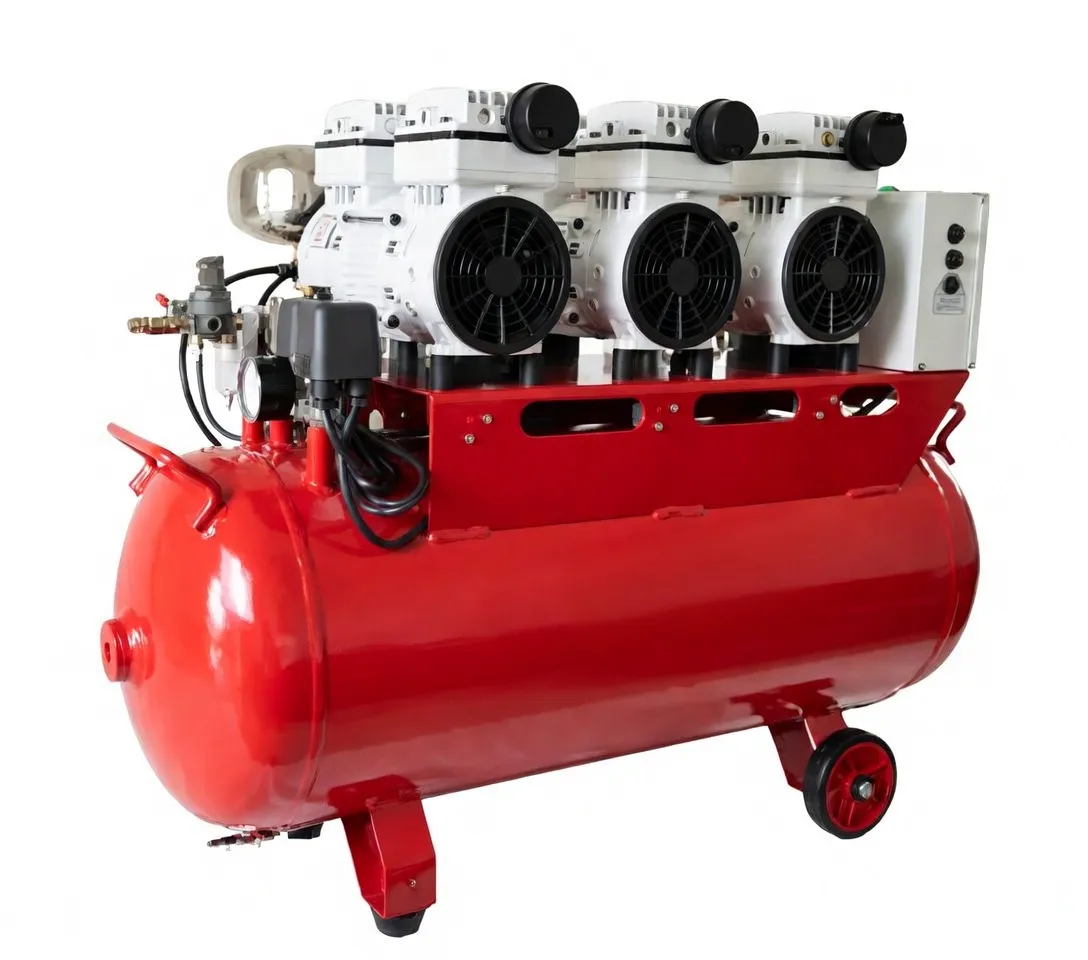
The term “oil-free” refers to the compressor’s internal compression stage, not merely downstream filtration. In a truly oil-free design — whether rotary screw, scroll, or centrifugal — the compression chamber is sealed with PTFE (polytetrafluoroethylene) coated rotors or carbon-ring seals that eliminate any need for oil as a lubricant or coolant within the compression zone. Bearings are housed in separate, sealed compartments with oil barriers preventing any migration into the air path. This is fundamentally different from an oil-injected screw compressor with coalescing filters; even a well-maintained filtration train cannot guarantee Class 0 purity if oil is present upstream.
For food packaging specifically, the two most relevant technologies are oil-free rotary screw compressors (best for continuous, high-volume MAP gas blanketing and pneumatic conveying of dry ingredients) and oil-free scroll compressors (preferred for smaller-scale packaging stations, laboratory gas supply, and installations where noise is a concern in open factory environments). Water-injected screw compressors offer a third route — using water as both coolant and seal medium — and produce genuinely ISO 8573-1 Class 0 air while also delivering lower outlet temperatures than dry types, which matters when packaging heat-sensitive products.
| Technology | Flow Range | Best For | Noise Level | ISO Class |
|---|---|---|---|---|
| Skru Putar Bebas Minyak | 2 – 100+ m³/min | High-volume MAP, conveying | 65–75 dB(A) | Class 0 / 1 |
| Oil-Free Scroll | 0.1 – 3 m³/min | Small lines, lab, packaging stations | 55–65 dB(A) | Kelas 0 |
| Skru Suntikan Air | 1 – 50 m³/min | Heat-sensitive products, low temp | 66–72 dB(A) | Kelas 0 |
| Centrifugal (Turbo) | 50 – 500+ m³/min | Large-scale bakeries, breweries | 70–80 dB(A) | Kelas 0 |
Application Scenarios in UK Food Packaging
The compressed air demands of a food packaging facility spread across several distinct process zones, each with its own purity, pressure, and flow characteristics. Understanding these separately is the first step in specifying a system that is neither over-engineered nor cutting corners where it counts.
MAP Nitrogen Flushing
Modified atmosphere packaging for crisps, nuts, and coffee uses nitrogen (N₂) or nitrogen/CO₂ blends to displace oxygen and extend shelf life by 3–6×. The PSA or membrane nitrogen generator feeding the MAP line requires oil-free compressed air as its feed gas. Any oil carry-over poisons the molecular sieve beds and contaminates the product gas — a dual failure mode that can halt an entire packaging line within hours.
Pneumatic Conveying — Dry Foods
Sugar, flour, cocoa powder, dried fruit, and puffed snacks are routinely transferred between silos, weigh hoppers, and packaging machines using dilute-phase or dense-phase pneumatic conveying. The conveying air envelops the product entirely. Oil-free compressed air at 0.5–1.5 bar gauge (dilute phase) prevents product absorption of taints while also protecting conveying pipe and filter sock assets from premature blocking caused by oil-coated particulate.
Sealing & Forming (VFFS / HFFS)
Vertical and horizontal form-fill-seal machines use compressed air at 5–7 bar to actuate jaw cylinders, cut blades, and registration systems. While this air does not directly contact product, in an open production environment it discharges close to open product streams. BRCGS auditors increasingly treat all exposed-zone air as potential contamination risk, recommending Class 1 or better throughout the production space.
Packaging Inflation & Cushioning
Air-cushion packaging systems and bag-in-box inflation lines for biscuits and confectionery require a clean, dry air supply to inflate void-fill films. Even indirect contact via packaging material makes oil-free air the appropriate specification, particularly for organic and premium product ranges where brand integrity and retailer codes of practice are closely scrutinised by buyers.
Technical & Performance Specifications
The table below captures the core performance parameters for Ever Power’s food-grade oil-free rotary screw compressor range. These figures are verified under ISO 1217 test conditions and represent continuous-duty performance at an ambient temperature of 20°C and altitude of 0–500 m. All units comply with the UK Pressure Equipment (Safety) Regulations 2016.
| Model | Power (kW) | Flow (m³/min) | Pressure (bar) | Noise dB(A) | ISO Class | Drive |
|---|---|---|---|---|---|---|
| EP-OF-11 | 11 | 1.3 – 1.8 | 7 / 8 / 10 | 64 | Kelas 0 | Fixed / VFD |
| EP-OF-22 | 22 | 2.6 – 3.7 | 7 / 8 / 10 | 66 | Kelas 0 | Fixed / VFD |
| EP-OF-37 | 37 | 4.4 – 6.2 | 7 / 8 / 10 | 68 | Kelas 0 | Fixed / VFD |
| EP-OF-55 | 55 | 6.8 – 9.5 | 7 / 8 / 10 / 13 | 69 | Kelas 0 | VFD Standard |
| EP-OF-75 | 75 | 9.2 – 13.0 | 7 / 8 / 10 / 13 | 71 | Kelas 0 | VFD Standard |
| EP-OF-110 | 110 | 14.0 – 19.5 | 7 / 8 / 10 / 13 | 72 | Kelas 0 | VFD Standard |
VFD = Variable Frequency Drive. Flow figures at rated working pressure. Custom pressure ranges and voltages available on request.
Why UK Food Manufacturers Choose Ever Power Pemampat Bebas Minyak
Certified Class 0 Purity
Third-party tested to ISO 8573-1 Class 0. Comes with traceable test certificates for BRCGS and retailer audits.
IE4 Motor + VFD Standard
IE4 super-premium efficiency motors with integrated variable frequency drives reduce energy consumption by up to 35% vs fixed-speed predecessors — critical against UK electricity costs above 25p/kWh.
6,000-Hour Service Intervals
PTFE-coated rotors and water-cooled aftercoolers extend rotor element service life to 6,000 hours between major services — minimising planned downtime on 24/7 packaging lines.
Low Discharge Temperature
Integrated water-cooled aftercoolers bring outlet air temperature to within 5°C of ambient, reducing dryer load and condensate volume — particularly valuable in high-humidity UK factory environments.
Smart IoT Controller
Integrated Modbus / PROFINET controller enables remote monitoring of pressure, temperature, dew point, and energy consumption — with OEE dashboard integration available for UK Industry 4.0 sites.
Food-Grade Material Standards
All air-path components — rotor housings, pipework connections, aftercooler cores — are manufactured from 316L stainless steel or food-approved anodised aluminium. Zero risk of metallic contamination into the product zone.
Keupayaan Pembuatan & Kejuruteraan Tersuai
Ever Power operates a 38,000 m² manufacturing facility with full in-house machining, rotor grinding, and assembly capabilities. Our engineering team includes 47 mechanical and electrical engineers with dedicated food and pharma industry experience. We understand that no two UK food factories share identical infrastructure — floor space, power supply, compressed air ring main layout, and existing nitrogen generation assets all differ — which is why product customisation sits at the core of what we offer, not the periphery.
Custom engineering services for food packaging applications include: bespoke pressure and flow configurations outside our standard range; stainless steel enclosures for wash-down environments; ATEX Zone 2 certified variants for flour mills and spice plants; integrated refrigerated and desiccant dryer packages factory-tested as a single unit; and silent canopy designs meeting 60 dB(A) targets for open-plan production environments in the UK where operator welfare regulations apply. Lead times for customised units run from 6–12 weeks ex-factory with CE/UKCA marking and full documentation packs.
47
In-house Engineers
6–12 wk
Custom Lead Time
38,000 m²
Factory Floor Area
UKCA / CE
Marking Standard
Customer Success: Midlands Snack Food Manufacturer, UK
Case Study: Hartley & Park Foods Ltd, Coventry — MAP Line Upgrade
Hartley & Park Foods had operated a conventional oil-injected compressed air system with high-efficiency coalescing filters for over a decade. Following a BRCGS AA audit in 2023 that flagged marginal Class 1 performance and an advisory note on compressed air purity documentation, the technical director initiated a project to upgrade the MAP line serving three nitrogen-flushed packaging machines running crisps and mixed nuts at 120 packs per minute.
After a site survey and flow profile analysis by Ever Power’s UK application team, two EP-OF-55 VFD units were specified in a lead-lag configuration with a shared 3,000-litre receiver and integrated cycling refrigerated dryer. The VFD drives allowed the lead machine to modulate between 30% and 100% capacity, tracking the variable demand from the nitrogen generator and VFFS sealing machines across three shifts.
32%
Energy saving vs previous system
Kelas 0
Purity achieved — verified quarterly
AA*
Next BRCGS audit result
14 mo
Full ROI payback period
Apa Kata Pelanggan Kami
“We’d been patching our old system with extra filters for years, pretending it was food-grade. The EP-OF-55 setup changed everything. Our compressed air audit documents are now a point of pride rather than something we hope auditors skim over.”
Technical Director, Hartley & Park Foods Ltd, Coventry
“We produce premium roasted coffee in Leeds and our buyers — including a major national supermarket — expect Class 0 documentation. Ever Power delivered a complete system with dryer, receiver, and distribution ring, commissioned on a Saturday so we didn’t lose a production day.”
Operations Manager, Northern Roast Co., Leeds
“The VFD on our EP-OF-37 makes a real difference. Demand fluctuates wildly between shift start-up and steady state on our biscuit lines. The compressor just follows it without us touching a thing. Energy bill is down noticeably.”
Engineering Manager, Ashworth Biscuits Ltd, Bristol
Soalan Lazim
Speakable content: This FAQ section is structured for voice search and assistant readability.
Ready to Upgrade Your Food Packaging Compressed Air System?
Get a tailored proposal from Ever Power’s food industry application team. We cover all UK regions and provide full ISO 8573-1 documentation, UKCA marking, and commissioning support.
[email protected] · Response within 24 hours · No obligation
© Ever Power Compressor Systems · UK Distribution Network · UKCA & CE Certified · ISO 8573-1 Class 0 Verified
suntingan oleh gzl