
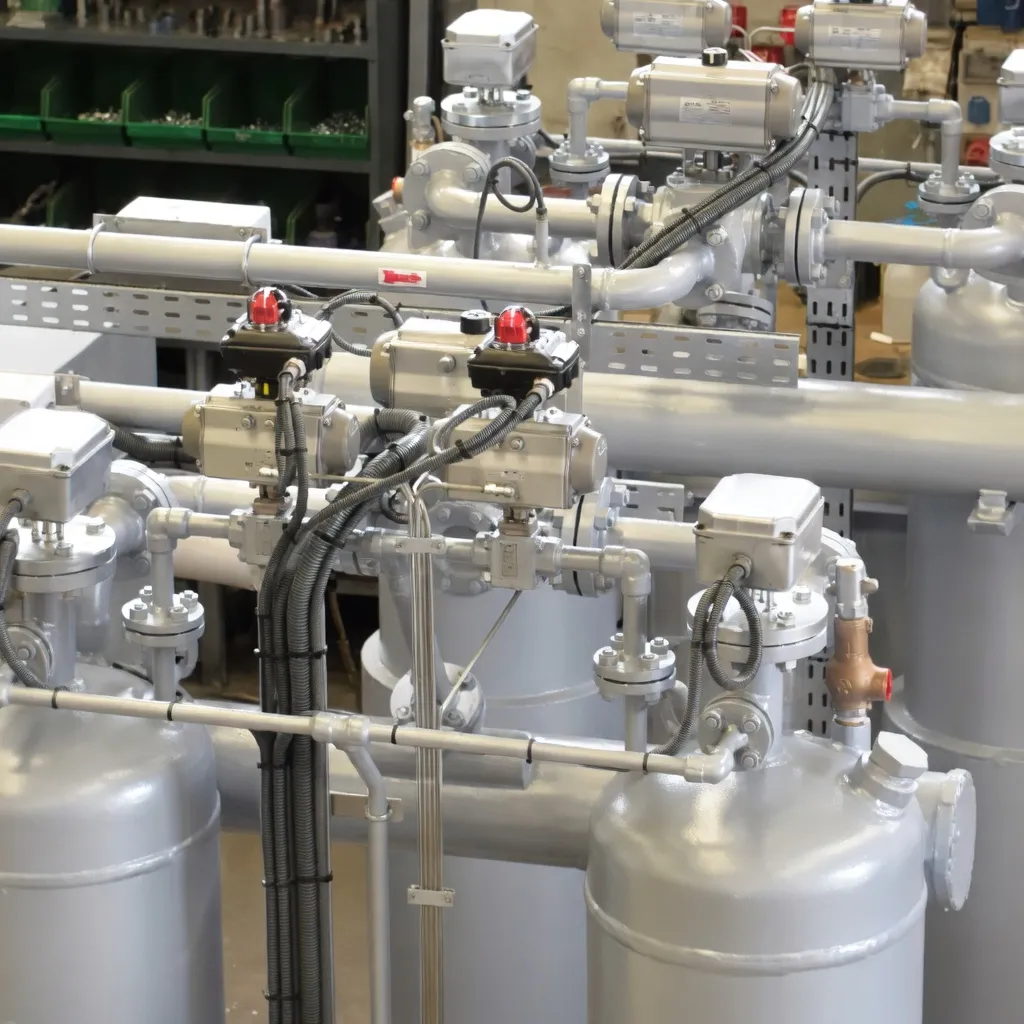
 Nuclear power generation demands a level of engineering precision that most industries never encounter. Within the instrumentation and control (I&C) architecture of any commercial reactor — be it a pressurised water reactor, advanced gas-cooled reactor (AGR), or a next-generation EPR — compressed air is not simply a utility. It is a safety-critical medium whose purity can determine whether a reactor trips safely or continues operating under fault conditions. The smallest trace of hydrocarbon contamination, moisture ingress, or particulate debris in a pneumatic line can cause a pilot valve to stick, a positioner to drift, or a containment isolation valve to fail closed at precisely the wrong moment. That is why every credible nuclear operator worldwide specifies oil-free compressed air for instrument air supply — and why the choice of compressor technology carries regulatory weight far beyond the machinery room.
Ever Power oil-free screw air compressors have been engineered from the outset for environments where failure is not an option. Our machines comply with ISO 8573-1 Class 0 — the internationally recognised standard that defines truly oil-free compressed air — and are validated for nuclear safety-grade applications in line with IAEA NS-G-1.3 guidance and the requirements of the UK’s Office for Nuclear Regulation (ONR). Whether you are commissioning a new instrument air header for Hinkley Point C, replacing ageing compressor sets at a Magnox decommissioning site managed by the Nuclear Decommissioning Authority (NDA), or upgrading the instrument air package for an EDF Energy AGR station, our oil-free screw compressors deliver the baseline reliability that nuclear safety cases require.
In the sections below, you will find a detailed account of the engineering principles behind oil-free screw compression, a full set of performance parameters, application-specific guidance for nuclear I&C circuits, and real-world evidence from operating nuclear projects in the United Kingdom and beyond. If you are at the early stages of a project specification, or reviewing options for a like-for-like replacement, this page is written to give you the technical depth and commercial confidence to make the right decision.
✉ Request a Nuclear Project Quote
Our engineering team responds within one business day. NDA-aware project timelines accommodated.
Why It Matters
Oil-Free Instrument Air: The Non-Negotiable Baseline for Nuclear I&C
Safety Valve Integrity
Oil aerosols at concentrations as low as 0.01 mg/m³ can cause pneumatic valve seats to swell, stick, or fail to reseat. In a safety instrumented system, a stuck-open or stuck-closed valve directly challenges the plant protection function — an outcome that regulators treat as a safety significant failure.
Regulatory Compliance
The ONR’s Safety Assessment Principles and IAEA Safety Standards Series NS-G-1.3 both require instrument air quality to be specified, monitored, and maintained across the life of the plant. ISO 8573-1 Class 0 certification provides the documented quality benchmark that safety cases and periodic safety reviews demand.
Артықшылық архитектурасы
Nuclear I&C instrument air systems are configured on a 2×100% or N+1 basis so that a single compressor failure — whether planned or unplanned — does not interrupt the instrument air supply header. Ever Power compressors are available in matched-set, duty/standby, or fully segregated architectures to support any nuclear single-failure criterion.
Long Service Life
A nuclear plant’s design life runs to 40–60 years, with each instrument air compressor expected to operate for 60,000+ hours across planned outage windows. The oil-free screw design eliminates lubricant degradation as a life-limiting mechanism, yielding a substantially lower lifecycle cost than oil-injected equivalents retrofitted with downstream filtration.
Engineering Principle
How an Oil-Free Screw Compressor Achieves Class 0 Air Purity
The oil-free screw compressor operates on the same helical intermeshing rotor principle as its oil-injected counterpart, but with a fundamentally different approach to rotor clearance management and thermal control. In an oil-injected machine, lubricant fills the minute clearance between male and female rotors, performing three simultaneous roles: sealing the compression chamber to prevent blow-by, cooling the compression process to manage discharge temperatures, and lubricating the rotor profiles to prevent metal-to-metal contact. Remove the oil, and all three functions must be addressed by alternative means.
Ever Power achieves this through a two-stage compression design with an interstage air cooler. In the first stage, ambient air is drawn across precision-machined rotors held in clearance by PTFE-composite timing gears rather than oil films. The rotors are coated with a specialised non-stick polymer layer that maintains the sealing land without any hydrocarbon lubricant in the compression chamber. Compression raises the air temperature; the interstage cooler then strips the heat and removes condensed moisture before the second stage brings the air to its final delivery pressure. Gear lubrication is confined entirely to sealed bearing chambers separated from the compression path by shaft seals and labyrinth barriers, ensuring that not even lubricant vapour migrates into the process air stream.
The result is compressed air that contains, by measurement, zero detectable oil — verified in line with ISO 8573-1 Class 0 requirements via total oil content analysis at the compressor outlet. For nuclear instrument air applications, the output is then passed through a dedicated refrigerant-type air dryer and a redundant coalescing filtration train, bringing moisture dewpoint to −40 °C pfd or better and particles to ISO Class 1. This integrated package is what we supply as a skid-mounted, pre-commissioned instrument air unit ready for connection to the nuclear instrument air header.
Technical Data
Performance & Specification Parameters
The following specification matrix covers the standard nuclear I&C instrument air package range. Custom configurations — including higher-pressure variants for specific positioner requirements, ATEX-rated enclosures for Zone 2 electrical areas, and low-noise acoustic canopies for control building installations — are available on request.
| Параметр | Specification / Range | Nuclear Relevance |
|---|---|---|
| Compressor Type | Two-stage oil-free rotary screw | No oil in compression path; ISO Class 0 achievable |
| Air Purity Class | ISO 8573-1 Class 0 (total oil < 0.01 mg/m³) | Mandatory for nuclear safety-grade instrument air |
| Delivery Pressure | 7.0 – 13.0 bar g (adjustable) | Covers full range of nuclear pneumatic actuator requirements |
| Free Air Delivery | 2.5 – 22.0 m³/min (per unit) | Scalable for single-reactor or multi-unit station header |
| Moisture Dewpoint | −40 °C pfd (with integrated dryer) | Prevents ice formation and corrosion in I&C tubing |
| Particle Content | ISO 8573-1 Class 1 (≤ 0.1 µm / 0.1 mg/m³) | Protects orifice plates, nozzle-flapper transmitters |
| Drive Motor Class | IE3 / IE4 premium efficiency, IEC 60034 | Reduced operating cost; aligned with UK net-zero commitments |
| Басқару жүйесі | PLC with Modbus / PROFIBUS / HART I/O | Integrates with plant DCS / SCADA for remote monitoring |
| Шу деңгейі | ≤ 72 dB(A) @ 1 m (standard canopy) | Suitable for occupied compressor houses near control buildings |
| Ambient Temperature Range | −5 °C to +45 °C (extended range options) | Operable in UK coastal plant environments year-round |
| Redundancy Configuration | 2×100% duty/standby or N+1 multiple-unit | Meets nuclear single-failure criterion requirements |
| Design Service Life | ≥ 60,000 operating hours (major overhaul interval) | Aligned with nuclear plant outage planning cycles |
| Сертификаттар | ISO 9001 | ISO 8573-1 Class 0 | CE | UKCA | IAEA-compatible | Full documentation pack for nuclear safety case submission |
Where It Works
Critical I&C Applications Powered by Oil-Free Instrument Air
Safety Instrumented System (SIS) Actuation
Pneumatic SIS final elements — including process isolation valves and trip valves — rely on clean, dry instrument air to maintain their fail-safe position under power loss or logic solver command. Ever Power compressors supply the header pressure and flow stability that eliminates spurious trips due to air pressure variations, with pressure tolerance held to ±0.15 bar across the full demand range of the SIS loop.
Containment Isolation Valves
The primary containment boundary depends on air-operated isolation valves closing within defined stroke times following a containment isolation signal. Any degradation in instrument air supply quality — whether from oil fouling, moisture freezing, or pressure loss — directly threatens the leak-tightness of the containment envelope. Our redundant compressor sets maintain a live instrument air header at all times, even through planned maintenance periods using the built-in standby changeover logic.
Reactor SCRAM & Emergency Shutdown
Emergency shutdown systems — whether hydraulic or pneumatically-assisted reactor trip breaker mechanisms — demand ultra-reliable motive air supplies with defined minimum header pressures. Ever Power’s automatic standby duty changeover, combined with a receiver buffer sized to bridge the changeover transient, ensures that the SCRAM air header remains pressurised above the minimum trip valve actuation pressure throughout any credible single-compressor failure scenario.
Emergency Core Cooling System (ECCS)
ECCS accumulator charging, ECCS injection line valve actuation, and core spray initiation logic all have pneumatic elements that must function during and after design-basis events including seismic events and station blackout scenarios. Instrument air compressors supplied to ECCS-related circuits are specified with seismic qualification documentation (IEEE 344 methodology) and emergency diesel-backed power distribution — both features Ever Power’s nuclear package supports as standard options.
Why Ever Power
Six Engineered Advantages for Nuclear Instrument Air
Zero Oil Carryover — Verified
Each unit ships with a factory-issued ISO 8573-1 Class 0 test certificate from an accredited third-party laboratory. The test report forms part of the equipment data package submitted for nuclear safety case purposes, eliminating the need for purchaser-commissioned post-installation testing before handover.
Full Documentation Package
Nuclear procurement demands material traceability, weld inspection records, FAT/SAT protocols, and operation and maintenance manuals formatted to client specification. Ever Power maintains a dedicated nuclear documentation team who produce compliant data books for ONR-regulated sites, NDA framework contracts, and EDF Energy procurement requirements — all under our ISO 9001-certified quality management system.
Seismic Qualification Available
For safety-classified instrument air applications at new-build nuclear facilities — including Hinkley Point C — Ever Power can supply compressor packages with seismic anchorage design documentation, shake-table test reports aligned with IEEE 344, and structural calculations certifying performance at the site-specific ZPA. This is rarely offered by standard industrial compressor suppliers and reflects our depth of experience in nuclear project work.
Automatic Duty/Standby Changeover
The integrated PLC control panel monitors discharge pressure and compressor health signals from both units simultaneously. A pressure drop below the low-pressure setpoint — or a fault signal on the duty compressor — triggers automatic standby start and changeover within three seconds, faster than most pneumatic header receivers deplete to minimum instrument air pressure. Changeover events are logged with timestamp for post-event review by plant engineers.
Low Lifecycle Cost
Eliminating oil means eliminating the oil separator element, inline oil-removal filters, and the scheduled oil changes that oil-injected machines require every 2,000–4,000 hours. Over a 20-year operating period at a nuclear site, the avoided maintenance cost — combined with the IE4 motor’s reduced energy consumption — typically delivers a lifecycle saving of 30–40% against an equivalent oil-injected package with downstream filtration to Class 1.
Remote Monitoring & Alarm Integration
Plant DCS integration is standard. Modbus RTU, PROFIBUS DP, or 4–20 mA hard-wired I/O outputs allow the instrument air system status — running state, header pressure, outlet dewpoint, air quality monitor alarms, and compressor fault conditions — to be annunciated at the main control room and incorporated into the plant alarm management system without additional engineering.
Customer Success
UK New-Build Nuclear Project — Somerset, England
Project: Instrument air supply package for a major nuclear new-build project in Somerset, England. The project required a complete skid-mounted instrument air package to supply the plant’s safety I&C circuits, including SIS final elements and containment isolation valves, during construction commissioning and through initial nuclear operation.
Requirement: The client specification called for a 2×100% redundant oil-free screw compressor package delivering a minimum of 14 m³/min at 8.5 bar g, with ISO 8573-1 Class 0 air purity verified at the compressor outlet. Full seismic qualification documentation and ONR-compatible data books were required for the safety submission. The package needed to fit within a compact compressor room layout with restricted headroom of 3.8 m.
Ever Power Solution: We supplied two matched 8.0 m³/min units (combined 2×100% at 16 m³/min with margin) on a common structural steel base with a low-profile acoustic canopy of 3.6 m installed height. The integrated control panel provided automatic duty/standby changeover with <3 s transition time, Modbus TCP/IP DCS interface, and continuous oil content monitoring via a parametric air quality sensor with 4–20 mA output. Both units were factory-accepted under a witnessed FAT attended by the client’s QA inspector.
What Our Nuclear Clients Say
“The documentation pack Ever Power delivered was the most complete we have received from any rotating equipment supplier on this project. The FAT records, FMEA, and material traceability certificates all came in the correct format for our nuclear QA system without a single revision request — genuinely rare in our experience.”
— Senior Mechanical Engineer
Nuclear Engineering Contractor, Somerset
“We had a tight schedule pressure on getting the instrument air system commissioned ahead of the SIS performance testing window. Ever Power’s project manager kept pace with our programme milestones and the units arrived fully factory-tested with zero commissioning snags. The standby changeover worked first time on site testing — exactly what you need on a nuclear programme.”
— I&C Commissioning Lead
Nuclear Systems Integrator, North West England
“We replaced three ageing oil-injected compressors with Ever Power oil-free units at our AGR station. The maintenance workload dropped significantly — no more oil filter changes, no more weekly oil level checks, and the air quality monitor has not triggered a single high-oil alarm since installation. Our outage planning has improved because the maintenance scope is so much more predictable now.”
— Maintenance & Reliability Manager
EDF Energy AGR Station, Scotland
Manufacturing & Customisation
Engineered to Your Nuclear Project Specification — Not the Other Way Around
No two nuclear instrument air systems are identical. Operating pressures, space envelopes, electrical classification areas, documentation requirements, and procurement standards differ from station to station and project to project. Ever Power’s manufacturing facility operates as a project-based customisation house rather than a catalogue supplier. Our engineering team works directly with your project engineer, instrument designer, or systems integrator from the enquiry stage, using your P&ID, instrument air demand calculation, and room layout drawing as the basis for a bespoke package design — not a standard product with add-ons.
Typical customisation options for nuclear instrument air applications include: ATEX Zone 2 rated electrical enclosures (Ex d IIB T4 or Ex e), low-profile canopy designs for restricted headroom installations, marine-grade paint systems for coastal nuclear sites such as Sizewell and Dungeness, stainless steel pipework within the package boundary for high-purity circuits, nitrogen purge capability for start-up in contaminated atmospheres, and diesel generator load shedding logic for blackout start sequences. All customisation work is carried out under change control within our nuclear project quality plan and documented in the as-built equipment data book.
Standard Nuclear Package Options
UK Nuclear Sector
Supporting the UK’s Nuclear Fleet — From New Build to Decommissioning
The United Kingdom operates one of Western Europe’s most diverse nuclear programmes, spanning EDF Energy’s fleet of seven AGR stations and the PWR at Sizewell B, the developing new-build programme anchored by Hinkley Point C in Somerset, and the extensive decommissioning estate managed by the Nuclear Decommissioning Authority (NDA) — which includes Sellafield in Cumbria and the legacy Magnox fleet at sites from Dungeness in Kent to Torness in East Lothian. Each of these environments presents distinct compressed air challenges, and Ever Power has built its nuclear product range specifically around the UK regulatory and operational landscape.
At the EDF AGR stations — Heysham 1 and 2, Hartlepool, Hunterston B, Hinkley Point B, Torness, and Dungeness B — the pressurised CO₂ reactor circuits mean that instrument air quality is scrutinised even more carefully than at water-cooled plants, since CO₂ contamination and moisture management interact with the reactor chemistry programme. Instrument air compressors at these sites are subject to EDF’s Centralised Technical Specification for compressed air systems, and Ever Power’s nuclear package is designed to align with those requirements in full.
At Sizewell B — the UK’s only operational PWR — and at the emerging Sizewell C project under development by EDF and NNB GenCo, instrument air systems must meet Western PWR design standards more closely aligned with the international EPR/AP1000 heritage. Our compressor packages are compatible with both the American and European nuclear instrument air supply philosophies, making us a practical single-source supplier across the UK’s mixed fleet.
For the NDA’s decommissioning estate at Sellafield and the Magnox sites, instrument air quality remains a live safety concern throughout defuelling, pond emptying, and building demolition phases — many of which retain pneumatically-operated safety barriers and containment isolation systems. We supply replacement compressor packages on an like-for-like basis for NDA-managed sites, with short delivery lead times and logistics support for sites in remote locations such as Chapelcross, Dounreay in Caithness, and Trawsfynydd in North Wales.
Жиі қойылатын сұрақтар
Nuclear I&C Compressor FAQs — Answered by Our Engineers
Ready to Specify a Nuclear-Grade Instrument Air Solution?
Share your project’s P&ID, instrument air demand calculation, and site requirements. Our nuclear applications engineers will return a detailed technical proposal within one working day — including equipment data sheet, preliminary documentation list, and indicative pricing.
📧 Get Your Nuclear Project Quote Today
[email protected] | Nuclear enquiries welcome from UK-registered contractors and NDA supply chain partners