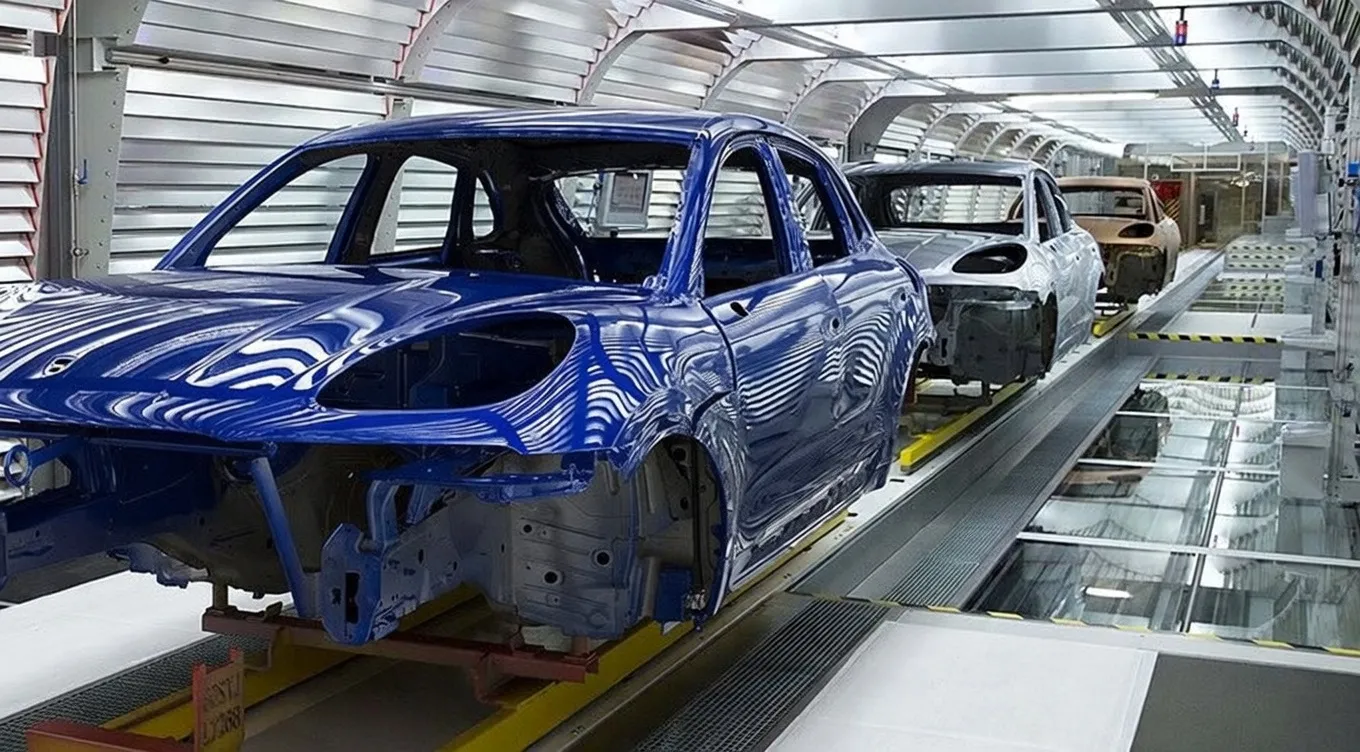
Walk through any modern automotive coating facility — whether it’s a busy bodyshop in Birmingham or an OEM paint plant in Sunderland — and you’ll notice the same thing: the spray guns are only as good as the air behind them. Primer, basecoat, clearcoat, and every layer in between demand compressed air that is genuinely dry, genuinely oil-free, and delivered at rock-solid pressure. The moment that standard slips, you’re looking at fisheye craters, pinholes, adhesion failures, and orange-peel texture that costs far more to fix than the equipment investment that could have prevented it. This is the core reason why the oil-free screw air compressor has become the default compressed air source on every serious automotive painting line worldwide — from Tier-1 supplier premises in the West Midlands to prestige coachbuilders in Yorkshire.
Compressed air quality isn’t a theoretical concern in vehicle painting — it’s a financial one. Industry estimates suggest that a single rework cycle on a mid-size passenger car can cost upwards of £400–£900 in labour, consumables, and downtime, not counting the reputational damage if a defect reaches the customer. The ISO 8573-1 standard that governs compressed air purity exists precisely because the industry learned this lesson the hard way. In this article, we break down everything a UK automotive operator needs to know: how the technology works, what specifications actually matter, where oil-free screw compressors outperform piston and rotary-vane alternatives, and how real body shops are recording measurable ROI.
🔧 Get a Free Quote from Ever Power →
Customised solutions for UK automotive spray booths & OEM paint lines · Reply within 24 hours
Why Oil in Compressed Air Is the Number-One Coating Defect Trigger
Most spray-related paint defects that appear in QC inspection are not caused by bad paint, bad technique, or even bad equipment — they’re caused by contaminated air. Oil aerosols from standard lubricated compressors pass through even multi-stage coalescent filters in concentrations that are invisible to the naked eye but catastrophic to a fresh paint film. When oil droplets land on a freshly atomised coating surface, the surface tension differential causes the surrounding paint to pull away, creating the classic fisheyedefect. At baking temperatures in a cure oven (typically 140–160 °C for OEM lines), any residual oil carbonises under the lacquer, forming microscopic craters that only reveal themselves after cooling.
Water contamination compounds the problem. Compressed air that hasn’t been adequately dried carries condensate that causes blistering, poor adhesion of waterborne basecoats, and pressure-drop fluctuations during spraying. For UK automotive operators using the increasingly prevalent waterborne paint systems — now mandatory under VOC regulations — the air dryer specification is just as critical as the compressor itself. A dew point of −40 °C or lower, achieved through refrigerated drying followed by adsorption (desiccant) drying, is the recognised benchmark for automotive coating air supply.
The financial maths are straightforward. One contaminated compressor producing even Class 2 air (per ISO 8573-1) rather than Class 0 oil-free air across a spray booth can introduce enough aerosol oil to cause intermittent defects throughout a working day. A typical bodyshop reworking three vehicles per week due to air quality issues is looking at direct costs of £60,000–£140,000 per year — before accounting for extended job turnaround times, paint material waste, and customer complaints. Against that backdrop, an investment in a properly specified oil-free screw air compressor package pays for itself in months, not years.
How an Oil-Free Screw Compressor Works — and Why It Matters for Automotive Painting
Twin Rotor Compression
Two precisely matched helical rotors — a male and a female — mesh and counter-rotate inside a stator housing. Air is drawn in, trapped between the rotor lobes, progressively compressed, and discharged. The critical difference in oil-free designs is that the rotor clearances are maintained mechanically with no lubrication in the compression chamber. Timing gears, located outside the compression stage, keep the rotors synchronised without direct contact.
Thermal Management
Without oil acting as a coolant and lubricant, oil-free compressors use either water injection or two-stage compression with intercooling to manage heat. Water-injected variants introduce treated water into the first compression stage, which provides cooling, sealing, and noise dampening simultaneously before the water is separated and recycled downstream. Two-stage dry-running designs rely on intercoolers between stages. Both approaches keep discharge temperatures within safe operational limits while guaranteeing zero oil carry-over.
Downstream Drying System
The air system doesn’t stop at the compressor. For automotive painting, compressed air is routed through a refrigeration dryer (achieving pressure dew points of −20 °C to −25 °C) and then through a twin-tower desiccant dryer loaded with activated alumina or molecular sieves to reach −40 °C PDP or lower. This combination ensures the air reaching the spray gun contains virtually no moisture — a non-negotiable requirement when applying waterborne coatings that are acutely sensitive to humidity and condensate contamination.
Technical Specifications — Ever Power Oil-Free Screw Air Compressor (Automotive Series)
The table below outlines the performance envelope of Ever Power’s automotive-grade oil-free screw compressors. Custom configurations — including non-standard voltage, enclosure ratings, and integrated dryer packages — are available on request for UK customers.
| パラメータ | EP-OF-7.5 | EP-OF-15 | EP-OF-30 | EP-OF-55 |
|---|---|---|---|---|
| モーター出力 | 7.5 kW | 15 kW | 30 kW | 55 kW |
| 無料航空配送(FAD) | 0.8 m³/min | 1.8 m³/min | 3.6 m³/min | 6.8 m³/min |
| Max Working Pressure | 10バール | 10バール | 10バール | 10バール |
| Oil Content (ISO 8573-1) | クラス0 | クラス0 | クラス0 | クラス0 |
| Pressure Dew Point (with dryer) | -40 °C PDP | -40 °C PDP | -40 °C PDP | -40 °C PDP |
| 騒音レベル | 62 dB(A) | 65 dB(A) | 67 dB(A) | 70 dB(A) |
| Drive Type | Direct / Belt | Direct / Belt | Direct | Direct |
| VFD (Variable Frequency Drive) | Optional | Optional | Standard | Standard |
| Voltage (UK Standard) | 415V / 3Ph / 50Hz | 415V / 3Ph / 50Hz | 415V / 3Ph / 50Hz | 415V / 3Ph / 50Hz |
| CE / PSSR Certification | ✔ Yes | ✔ Yes | ✔ Yes | ✔ Yes |
Where Oil-Free Screw Compressors Are Used in Automotive Painting Operations
The application of compressed air in an automotive painting environment is not limited to the spray gun. A modern coating line uses clean, dry air at multiple points — each with its own flow and quality demands. Understanding each stage helps operators size their compressor installation correctly and avoid the common mistake of under-specifying for peak demand.
Primer Spray Application
The first coating layer applied to bare or stripped metal. Primers are highly sensitive to surface contamination; even sub-micron oil droplets prevent proper bonding and lead to peeling within weeks of delivery.
Basecoat & Metallic Colour Layers
Metallic and pearl paints contain aluminium flakes or mica particles that align directionally during application. Pressure fluctuations or moisture ingress causes flake misalignment, producing mottled finishes that show clearly in raking light and cannot be corrected without full re-spray.
Clearcoat & Lacquer Application
The topmost transparent layer that provides gloss, UV protection, and scratch resistance. Clearcoat fisheye defects are the most visible and costly: the affected panel must be flatted back and re-cleared, adding hours of work per vehicle per incident.
Air-Powered Panel Preparation Tools
Orbital sanders, DA polishers, and air blow-off guns used during surface preparation all draw from the same compressed air ring main. Oil contamination here translates directly into panel surface contamination before painting even begins.
Spray Booth Air Knife & Blow-Off
Final dust blow-off prior to entering the paint booth is a standard protocol in quality-conscious facilities. Compressed air blow-off guns require clean, dry air to avoid depositing new contaminants on the freshly cleaned panel surface.
Automated Robotic Paint Lines
High-volume OEM and Tier-1 facilities operating automated spray robots demand 24/7 compressed air reliability with zero unplanned downtime. The oil-free screw compressor’s reduced maintenance schedule and redundancy-friendly modular design makes it the natural fit for round-the-clock production environments.
Key Advantages of Ever Power Oil-Free Screw Compressors for Paint Shop Operations
01
ISO 8573-1 クラス0認証取得済み
Zero detectable oil in the compressed air stream — not reduced oil, not filtered oil, but genuinely zero. This is independently verified to Class 0, the highest classification under the ISO standard, and eliminates the need for downstream oil removal filters in the spray line.
02
Lower Total Cost of Ownership
No oil changes, no oil filters, no oil separator elements, no oil disposal fees. The elimination of oil from the maintenance cycle reduces scheduled service costs substantially over a 10-year operational life. When combined with VFD-driven energy savings (typically 20–35% reduction in electricity consumption), the TCO argument for oil-free technology is compelling.
03
Consistent Pressure Stability
Screw compressors deliver continuous airflow with far lower pressure pulsation than reciprocating piston designs. For HVLP and electrostatic spray applications, stable inlet pressure at the gun translates directly into consistent atomisation pattern width, paint film thickness uniformity, and gloss level — measurable improvements that show up in final inspection pass rates.
04
Compact, Low-Noise Design
Ever Power’s automotive-series units are acoustically canopied to 62–70 dB(A), making installation inside or adjacent to working paint shop buildings practical without requiring separate compressor rooms. The compact footprint — significantly smaller than equivalent-capacity piston banks — simplifies installation in constrained bodyshop layouts typical of UK SME operations.
05
Full System Integration Ready
Ever Power units ship integration-ready with standardised connections for downstream refrigeration dryers, desiccant dryer towers, inline particulate filters, and pressure management manifolds. Remote monitoring via Modbus/RS485 or optional IoT gateway is available for larger installations seeking real-time air quality and energy data dashboards.
06
UK Regulatory Compliance
All Ever Power units supplied to UK customers carry CE marking and are designed to comply with the Pressure Systems Safety Regulations 2000 (PSSR). Documentation packages including Declaration of Conformity, pressure vessel test certificates, and written scheme of examination are provided as standard to support UK PSSR Written Scheme obligations.
Customer Success Story
Real results from a UK automotive coating operation — shared with permission
Meridian Refinishing Solutions Ltd
Sheffield, South Yorkshire, UK · Accident Repair & Fleet Refinishing
課題: Meridian Refinishing Solutions — a 14-bay accident repair centre serving insurance-approved fleet clients across South Yorkshire — had been running a bank of three ageing lubricated piston compressors for their two fully enclosed spray booths. Despite maintaining coalescent oil filters in line, the shop was recording between 8 and 12 paint defect incidents per week requiring rework, the majority attributable to fisheye and contamination-related failures. A contracted quality audit by their largest fleet insurer client flagged the compressed air system as the likely root cause. The business was facing a contract renewal review.
解決策: Working with their regional compressed air specialist, Meridian specified and installed two Ever Power EP-OF-15 oil-free screw compressors in a duty/standby configuration, paired with an integrated refrigerant dryer and twin-tower desiccant drying system delivering −40 °C PDP air to both booths through a dedicated oil-free ring main. The installation was completed over a single weekend to avoid production downtime.
The Outcome: Within the first four weeks of operation, paint-related rework incidents dropped from an average of 10 per week to fewer than 3, representing a 70%+ reduction in rework labour and material cost. After three months, the insurer quality audit passed with zero compressed air-related findings, and the fleet contract was renewed with an expanded scope. The general manager estimated direct savings of approximately £47,000 in the first year alone — against a total installation cost well below that figure.
What Our Customers Say
“We’d thrown money at filters and treatment for years and still had fisheye problems. Switching to the oil-free unit solved it in the first week. The quality difference is night and day — our painters noticed it immediately without us telling them anything had changed.”
“Ever Power’s team helped us size the system for our three-booth facility in Manchester and spec’d a custom voltage configuration for our site. The install was fast, the documentation was complete for our PSSR Written Scheme, and the units have run without a fault since commissioning 14 months ago.”
“As a prestige vehicle restorer, we can’t afford any defects. The EP-OF-30 with the full drying package gives us the air quality we need to apply heritage lacquers on vehicles worth six figures without any anxiety about contamination. It was the best capital expenditure decision we made last year.”
Ever Power Manufacturing & Custom Engineering Capability
Behind every Ever Power compressor is a purpose-built manufacturing facility with over two decades of concentrated focus on compressed air technology for demanding industrial applications. Our production site operates an integrated R&D centre, precision machining workshop, and acoustic testing laboratory — enabling the kind of tailored engineering that off-the-shelf compressor suppliers simply cannot offer. For UK automotive paint shop operators with non-standard requirements, this matters enormously.
Our custom engineering service handles a wide spectrum of special requirements: ATEX-rated variants for hazardous area paint spray booths, bespoke integrated skid packages combining compressor, dryer, filtration, and storage vessel in a single CE-marked assembly, stainless pipework manifolds for ultra-clean air distribution, and multi-machine master controller installations for facilities running parallel paint lines. We also offer OEM-badged supply for distributors and compressed air system integrators serving the UK automotive aftermarket. Documentation, certification, and technical support are delivered in English, and all equipment is specified to UK voltage and safety standards from the factory.
Ready to Specify the Right Compressor for Your Paint Shop?
Share your booth specifications, daily cycle requirements, and site constraints. Our engineering team will respond with a tailored recommendation and indicative price within one working day.
よくある質問
Common questions from UK automotive body shop managers, fleet refinishers, and OEM procurement teams
Ready to Eliminate Paint Defects at Your UK Facility?
Talk to our application engineers about your spray booth compressed air requirements. Custom packages, PSSR documentation, and UK-voltage configurations available as standard.
Ever Power · Oil-Free Screw Air Compressors for Automotive & Industrial Applications · UK B2B Enquiries Welcome · edit by gzl